


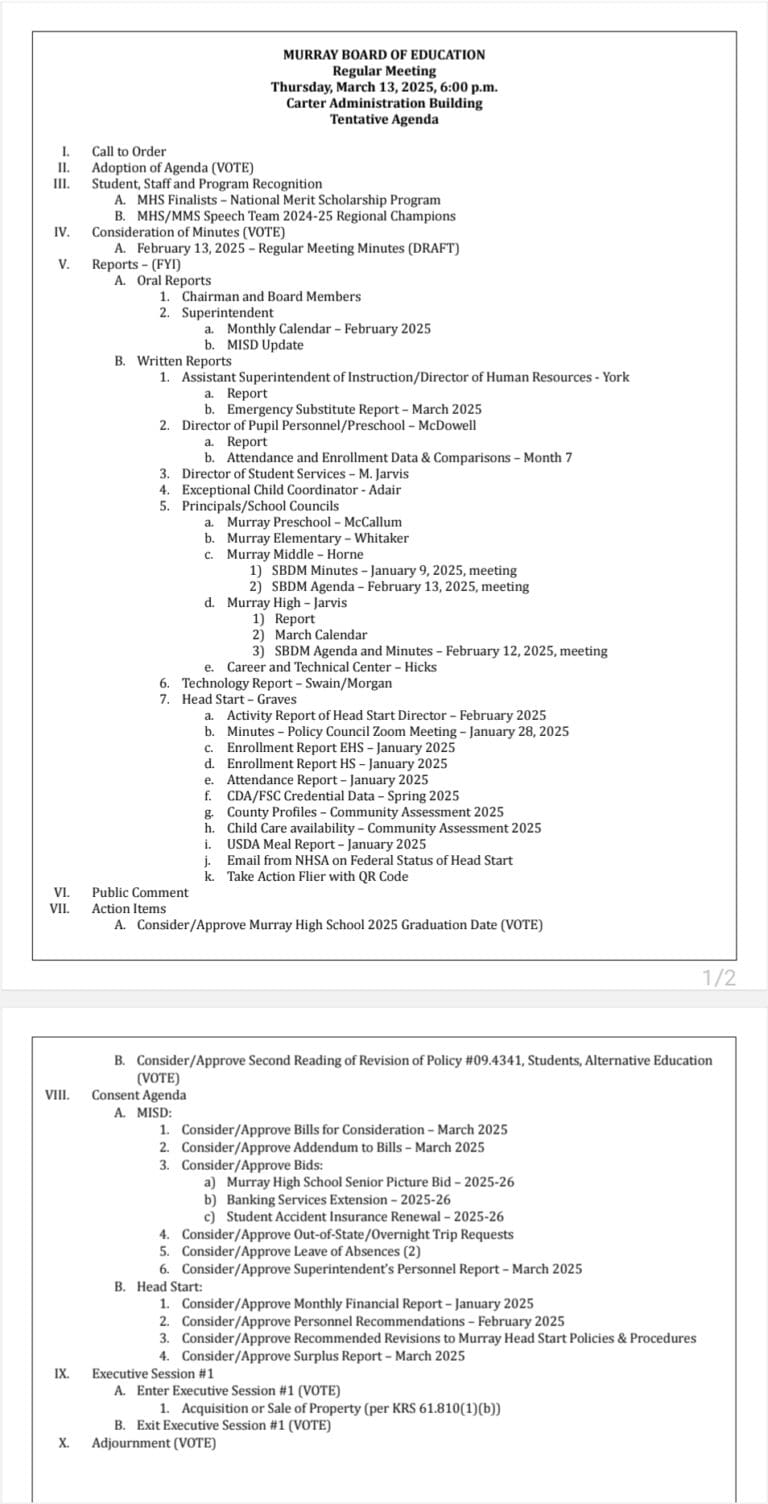
The Murray Board of Education will meet at 6 p.m. at the Carter Administration Building, 208 S 13th Street.
Murray Human Rights Commission Regular Meeting CANCELED
The Murray Human Rights Commission originally scheduled at 4:30 p.m. has been canceled.
MCCH Board of Trustees Quality Committee Regular Meeting
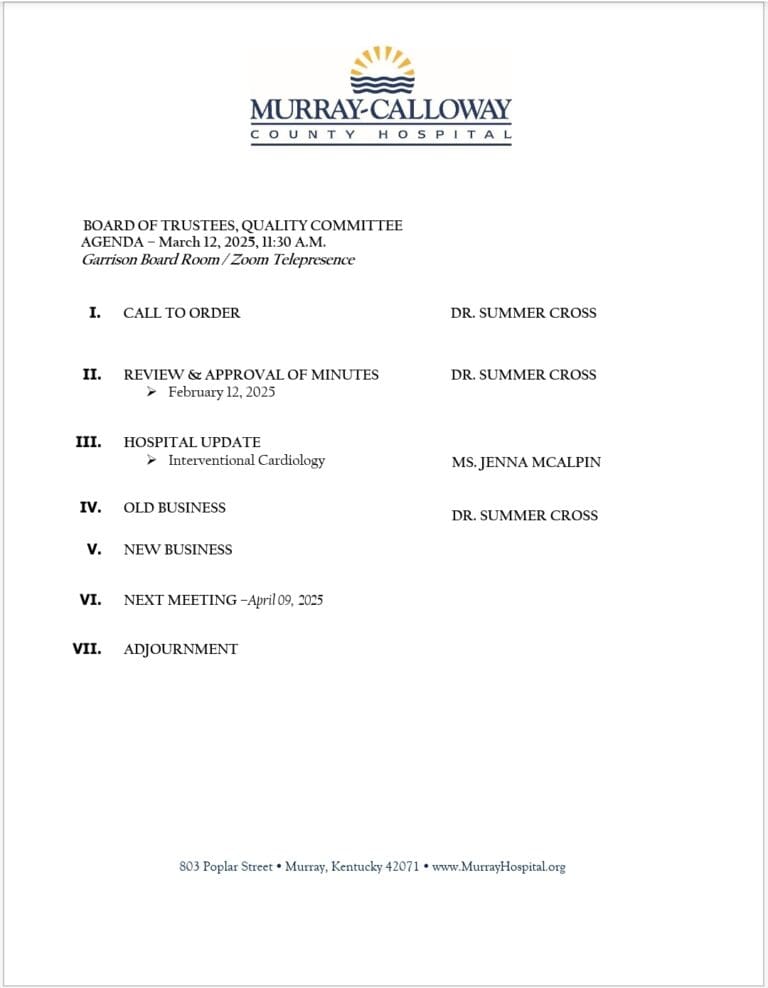
The Murray-Calloway County Hospital Board of Trustees Quality Committee will meet at noon in the hospital’s Garrison Board Room and viz Zoom (call 270-762-1102 for Zoom connection details).
MSU Board of Regents SPECIAL CALLED Meeting
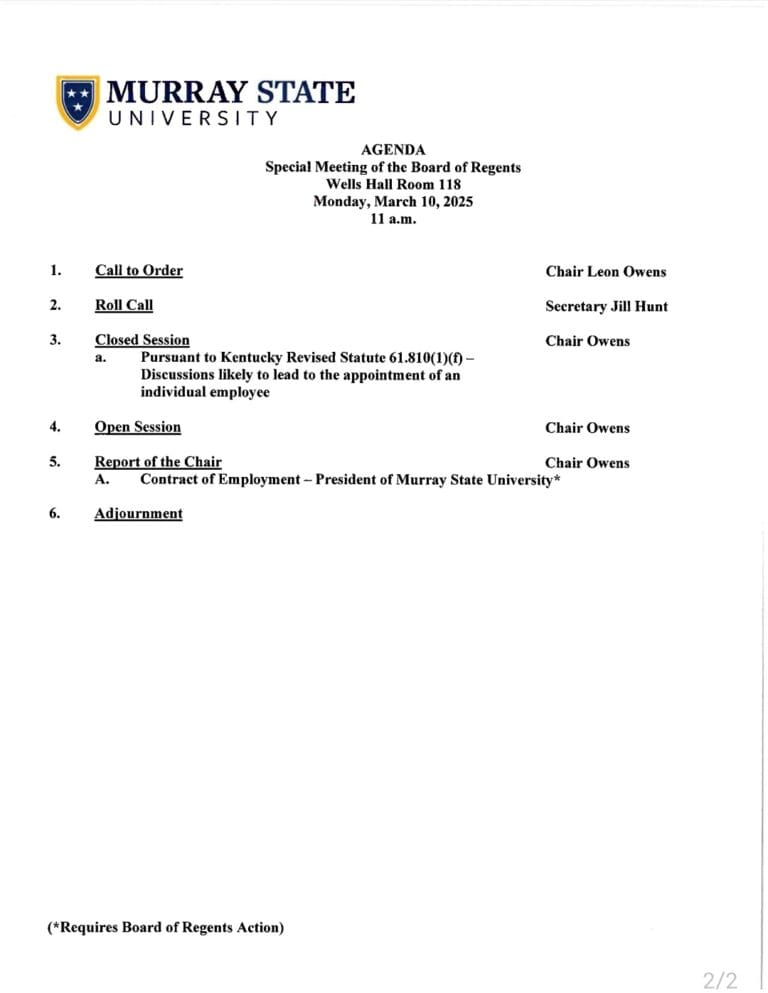
The Murray State University Board of Regents will hold a special called meeting at 11 a.m. in Wells Hall, Room 118. See agenda.
Man involved in summer stand-off with law enforcement charged with attempted murder
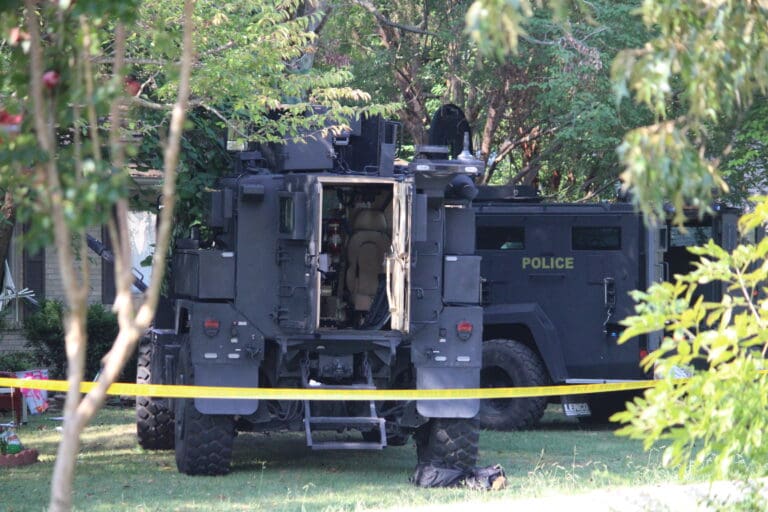
MURRAY – What started as a cry for help ended in disaster one late-August evening last summer when law enforcement officers responded to a welfare check at a Johnson Boulevard home after a crisis hotline worker alerted authorities that a man at the residence was experiencing a mental health crisis. The situation quickly escalated into a standoff, during which the man allegedly opened fire on officers, who returned fire, critically injuring him.
Nearly seven months later, Matthew Johnson, 40, who survived his injuries but is now confined to a wheelchair, faces charges of wanton endangerment, terroristic threatening and four counts of attempted murder.

On Aug. 23, 2024, at 4:13 a.m., the Murray Police Department (MPD) alerted the community of an “active incident” on the 1300 block of Johnson Boulevard in a Facebook post and urged motorists to avoid the area.
By daybreak, the “incident” was over, but the law enforcement presence, which included the Kentucky State Police (KSP), Marshall County Sheriff’s Office (MCSO) and MPD, remained heavy throughout the day, with the street closed to through traffic from Sunny Lane to Whitnell Avenue.
All three law enforcement agencies issued press releases that day, but details were scant. What was clear was that MPD was dispatched to Johnson Boulevard around 10 p.m. the night before. When officers arrived on scene, they found the man brandishing a firearm, which he allegedly pointed at the officers before barricading himself inside the residence. MPD requested assistance from the Marshall County Special Response Team (SRT) and obtained an arrest warrant.
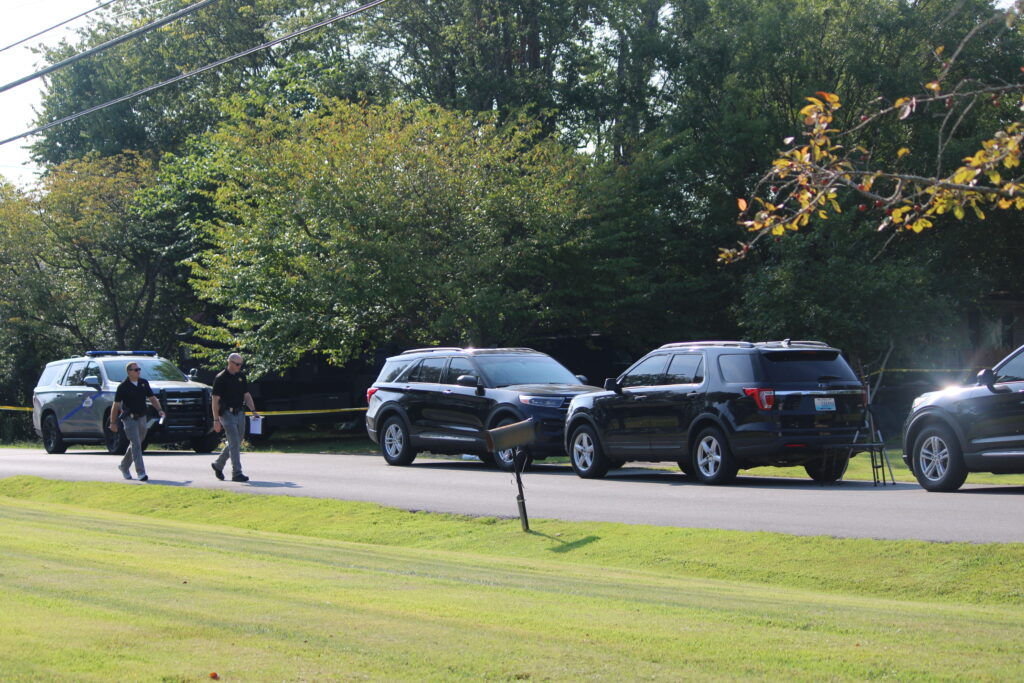
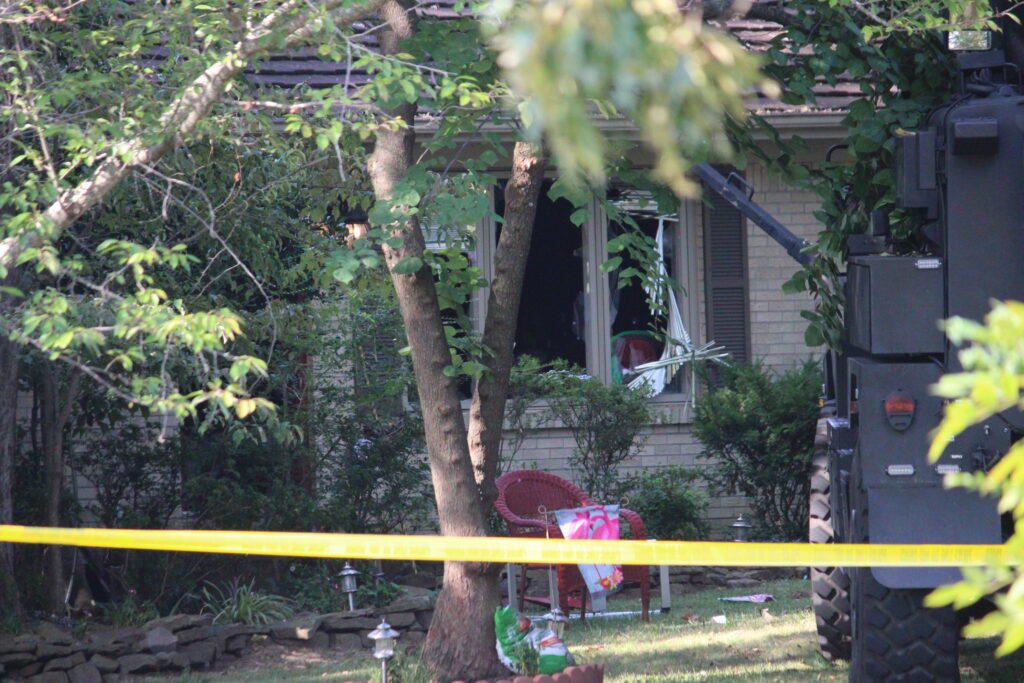
At some point after SRT arrived, the man allegedly opened fire on them, striking one officer multiple times. The remaining officers returned fire, striking the man, who sustained life-threatening injuries and was airlifted out-of-state for treatment. The officer was treated locally for non-life-threatening injuries and released. Per MCSO policy on officer-involved shootings, KSP was contacted to investigate.
On Sept. 5, with preliminary interviews complete and investigators’ initial findings submitted, KSP provided more details in a press release, which, among other things, identified Johnson as the suspect.
According to KSP, MPD officers arrived at the Johnson Boulevard home around 10:30 p.m. on Aug. 22 and encountered Johnson. During their interaction, Johnson allegedly pointed a rifle toward the officers, who retreated for cover, then he barricaded himself inside the home. At that point, MPD requested SRT’s assistance. MPD also secured a warrant for first-degree wanton endangerment and third-degree terroristic threatening.
Both MPD and SRT officers attempted to negotiate with Johnson with assistance from the crisis hotline operator but were ultimately unsuccessful as “Johnson refused to cooperate or work toward a peaceful resolution,” according to KSP.

Four and a half hours after the initial dispatch call went out, SRT officers deployed gas into the residence. Johnson allegedly responded by firing his rifle at the officers, hitting one in the arm and leg, causing non-life-threatening injuries. The remaining three officers then returned fire.
“Johnson was struck by officer gunfire and injured but remained inside the residence, ignoring officers’ requests to surrender for some time,” the release states. “Eventually, Johnson surrendered, at which time he was flown to a hospital in Nashville for medical treatment.”
Johnson was arrested Feb. 17 on the complaint warrant issued the night of the incident, which charged him with wanton endangerment and terroristic threatening, and an indictment warrant dated Dec. 20, charging him with four counts of attempted murder of a first responder. Johnson is being held in the Calloway County Detention Center on a $250,000 cash bond, which was set by the grand jury in the indictment.
On Feb. 18, he was arraigned in Calloway District Court on the wanton endangerment and terroristic threatening charges, which are in a separate case from the attempted murder charges as those charges came from a direct submission to the grand jury after KSP completed its investigation.
Calloway District Judge Randall Hutchens denied Johnson’s request for a public defender and instructed him to seek private counsel before his preliminary hearing on Feb. 26, but when Johnson appeared on the 26th, he advised the court that he was unable to find an attorney.
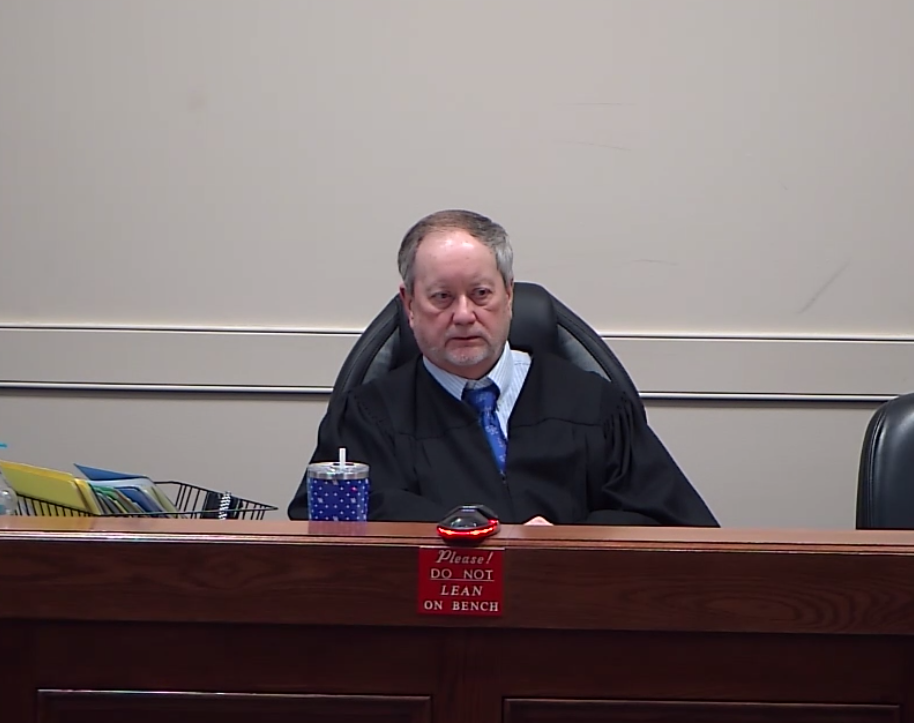
“I’m going to find good cause to continue your preliminary hearing because I want you to have a lawyer,” Hutchens said. “You need one upstairs (in circuit court). You need to get a lawyer for both these cases; I assume they’re somewhat related. … So, let’s talk about you need to get a lawyer this week.”
Johnson advised that he could not find an attorney who could meet with him before Monday.
“Well, Monday’s when you’re going to be upstairs,” Hutchens said, again referring to the circuit courtroom located on the second floor of the Calloway County Judicial Building. “You’ve got court in front of me, obviously, today, but we can put that off a week; but you’ve got court upstairs Monday as well, and that’s your bigger issue. … You need to have a lawyer next week. I’m trying to protect your rights, and one of the things you need is a lawyer.”
In Calloway Circuit Court on Monday, Johnson appeared for his arraignment without an attorney. After Assistant Commonwealth’s Attorney James Burkeen informed the court of the proceedings in district court, noting that Hutchens strongly advised Johnson to secure representation prior to Monday’s proceedings, Calloway Circuit Judge Andrea Moore asked Johnson why he had not yet obtained counsel.
“This is just a short list of who I’ve been in contact with,” Johnson said as he held up a piece of paper, “and the vast majority of them (believe they have) a conflict of interest because they’ve represented the police before; and then (for) some of them, it’s a distance issue; and (for) some, it’s financial issues – you know, $50-70,000 for representation that I just don’t have right now.”
Johnson further advised that he had an appointment scheduled with an attorney later that day, noting “that will be the first lawyer that’s actually agreed to meet with me.”
Moore said that she would not give him long and continued the arraignment to the next rule day, Monday, March 17, but warned, “By that time, you need to have counsel hired, okay?”
“And if I can’t, ma’am?” Johnson asked. Moore said that if he was still unable to hire an attorney by that time, she would consider “something different.”
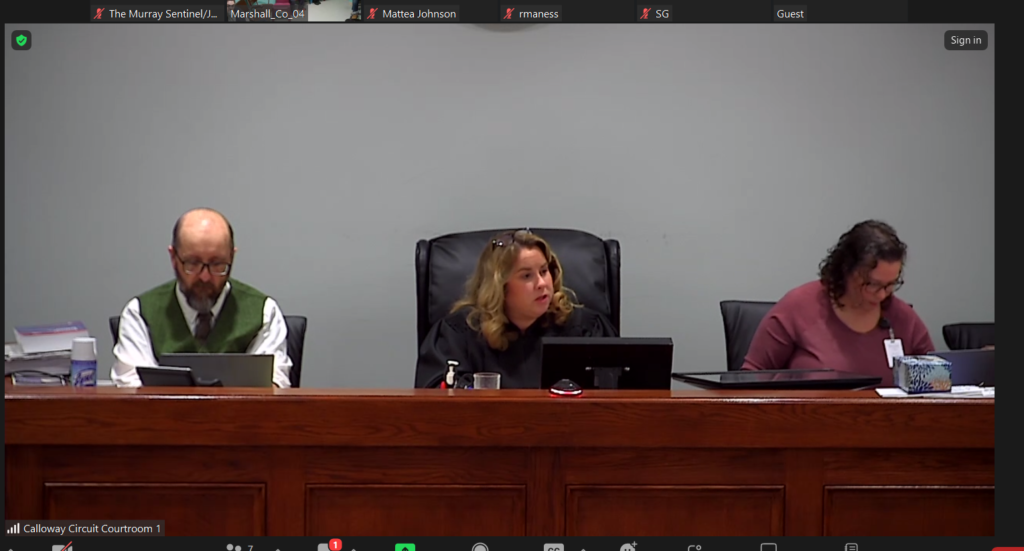
Back in district court Wednesday, Johnson appeared alone, again, for his preliminary hearing. When asked why there was no attorney present, Johnson said he found someone who will take the case, “but it won’t be until about September before I have the $30,000 to…”
“Alright,” Hutchens said, cutting the defendant off. “You have the right to a preliminary hearing. You can waive that preliminary hearing and send the matter to the grand jury, but that’s up to you. Would you like to talk to the Commonwealth’s Attorney before we proceed? … He doesn’t represent you; he’s the prosecutor. Do you want to talk to him before we have the hearing?”
Johnson declined, and the hearing began. Burkeen called MPD Patrol Officer Jacob Kramer, who was one of the officers who responded to the initial call, to testify. His testimony only pertained to the district court charges of wanton endangerment and terroristic threatening, not the attempted murder charges in Johnson’s circuit court case.
After establishing venue, Burkeen asked Kramer to explain the events that occurred the night of the incident.
“We were contacted by the suicide hotline in regards to a male subject that had contacted them,” Kramer testified. “We attempted to make contact at the front door. It appeared as if somebody was home. We continued to attempt to make contact. At one point, Mr. Johnson had crossed over into the living room, and we were able to have eyes on him. … I was at the back door of the residence, and Mr. Johnson had went to the back door of the residence. I was on the neighbor’s property to the west of that address, and he had opened the door and stepped out and told me, ‘Get the f— off my lawn.’ … I attempted to make contact with Mr. Johnson, but then he ran into residence and shut the door.”
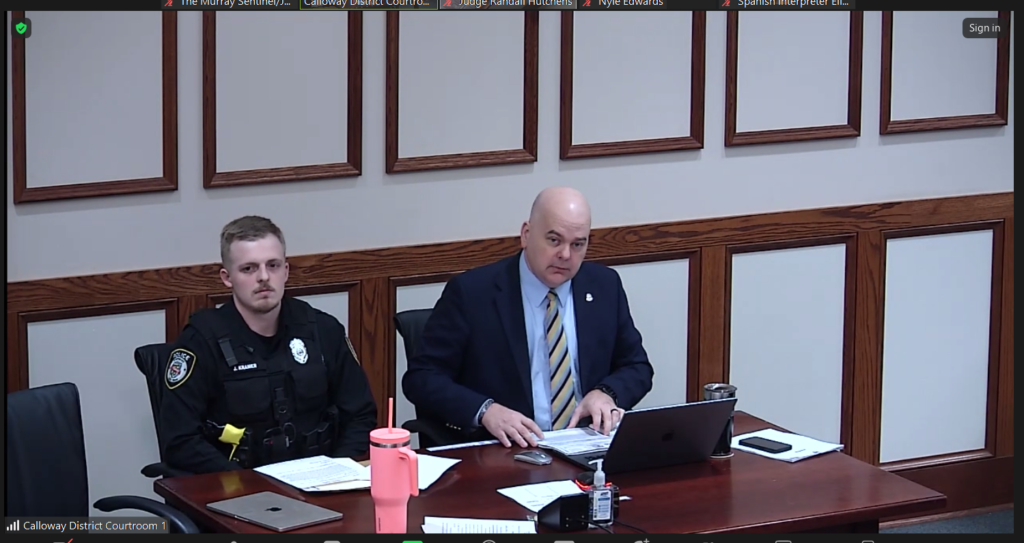
Other officers then observed Johnson go into the east end of the home but then lost sight of him. At some point after that, according to Kramer’s account, he reappeared, armed with a rifle, which he pointed in the direction of one of the officers. They took cover, and an hours-long stand-off ensued. MPD was assisted by the SRT and the Paducah Bomb Squad, Burkeen confirmed.
“The terroristic threatening was based on the comment (to officers about getting off his lawn), and then, more importantly, the wanton endangerment is pointing a rifle directly at an officer, is that correct?” Burkeen asked, seeking to clarify the basis of the charges.
Kramer confirmed the wanton endangerment charge stemmed from Johnson allegedly pointing his rifle directly at one of the officers but said the terroristic threatening charge was also connected to alleged threats Johnson communicated to police via the suicide hotline.
“He was telling the suicide hotline – which was being relayed back to the Murray Police Department – that, at first, if we entered the residence, that he was going to open fire on us; and then, after that, it was if we did not leave, he would open fire,” Kramer said.
Burkeen had no further questions.
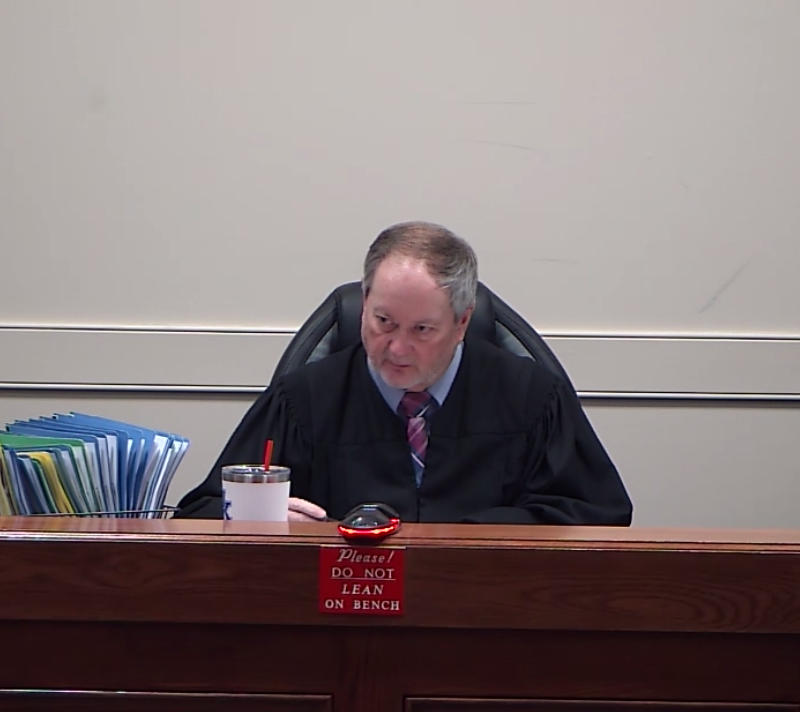
“Mr. Johnson, you don’t need to testify now – you need to wait until you have an attorney – you have the right to remain silent,” Hutchens advised, “but if you would like to ask the officer a question, you may do so. Would you like to ask a question?”
Johnson declined, and Hutchens ruled, “The court finds probable cause, binds the matter over to the grand jury. … Good luck, sir.”
Johnson’s next appearance will be Monday, March 17, at 8:30 a.m. in Calloway Circuit Court.
Individuals charged with crimes are presumed innocent until proven guilty in a court of law.
Editor’s note: If you or someone you know is in crisis, call the Suicide and Crisis Lifeline by dialing 988 or text SAVE to 741741.
March 17, 2025 Update
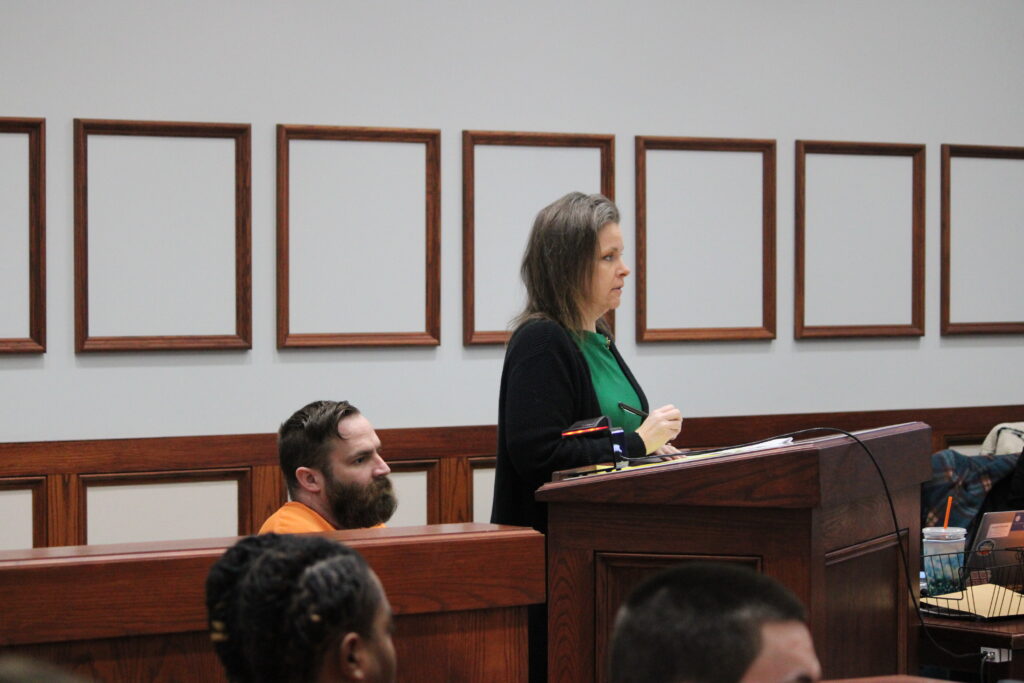
MURRAY – In Calloway Circuit Court this morning, Judge Andrea Moore appointed the Department of Public Advocacy to represent Matthew Johnson after he made his second appearance before her without an attorney. Johnson said that he still needs a couple of months to come up with the funds to hire private counsel, but Moore advised that the case cannot be put on hold for two months.
DPA Murray Trial Office Directing Attorney Cheri Riedel joined Johnson at the podium but advised that her office will need to retain a conflict attorney for the case, which she noted could take a little time. Moore ordered discovery and reciprocal discovery and set a review hearing on May 5 at 8:30 a.m.
Individuals charged with crimes are presumed innocent until proven guilty in a court of law.
Press release: Lane restriction planned Thursday to repair potholes on KY 1836 in Calloway County
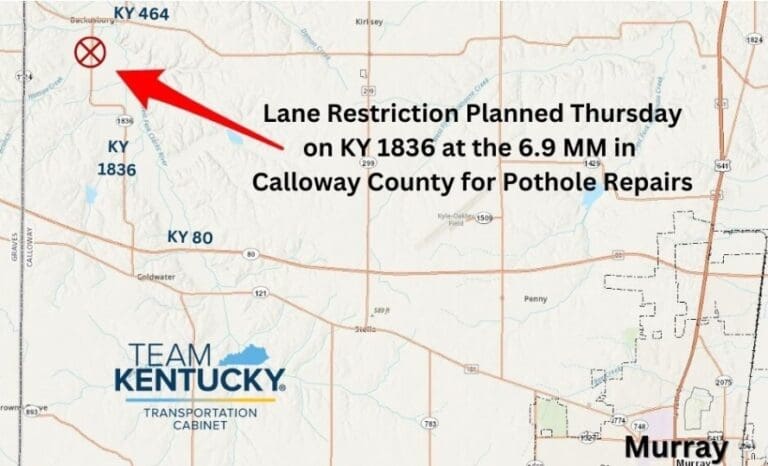
MURRAY – The Kentucky Transportation Cabinet (KYTC) is planning a work zone lane restriction on KY 1836/Hammond Road in Calloway County starting at 8 a.m. on Thursday, March 6. Flaggers will direct traffic around the work zone from 8 a.m. to 3 p.m.
A crew will be repairing potholes at the 6.9-mile marker of KY 1836, about 0.5 mile south of the intersection with KY 464/Backusburg Road.
Work is expected to be completed by 3 p.m.
Motorists should be alert for signage and one lane traffic with alternating flow controlled by flaggers. Use appropriate caution.
Kentucky Open Government Coalition issues statement on HB 520 (OPINION)

House Bill 520, “an act relating to law enforcement records,” is not — as its sponsor testified in the House State Government committee meeting on February 27 — a bill intended to “ensure clarity” of the nearly fifty years old law enforcement exception to the open records law.
With all due respect to the sponsor, there is no need for clarification.
Clarity was achieved in 2013 when the Kentucky Supreme Court decided City of Fort Thomas v Cincinnati Enquirer. The Court rejected law enforcement’s argument that it “need show no more than an entire file’s general relation to a possible enforcement action” to successfully deny the public access to every single record in that file while an investigation — that might lead to enforcement action — proceeds. In other words, the Court rejected law enforcement’s argument that an open records requester gets no records from a law enforcement agency while a case is “open.”
The Court reasoned that law enforcement’s “asserted presumption of harm” from disclosure of any record in an ongoing investigation — without concrete proof — would turn on its head the Open Records Act’s basic presumption of openness; create a blanket exemption for police files regardless of their contents; relieve law enforcement agencies’ of their statutory obligation to separate excepted materials (records ) from unexcepted materials, “mak[ing] the unexcepted material available for examination”; and reduce the statute’s harm requirement to “mere surplusage.”
Instead, the Court in City of Fort Thomas ruled:
“[T]he law enforcement exemption is appropriately invoked only when the agency can articulate a factual basis for applying it, only, that is, when, because of the record’s content, its release poses a concrete risk of harm to the agency in the prospective action. A concrete risk, by definition, must be something more than a hypothetical or speculative concern.”
HB 520, as amended, returns Kentuckians to the legal world as we knew it before the City of Fort Thomas v Cincinnati Enquirer. A few critical changes in wording — from “would” to “could,” — a hypothetical or speculative risk of harm, for example rather than an actual risk of concrete harm based on the individual record’s content, is sufficient to deny the public access to records in an open investigation and enforcement action.
“Concrete“ harm becomes “articulable“ harm —“capable of being expressed, explained, or justified” such that it might apply in any investigation and enforcement action/ prosecution, for example, “taint the jury pool” or “influence witness testimony.”
In a word, HB 520 creates a laxer, looser, and less onerous standard for denying the public access to records in an open case.
Even if HB 520 can be interpreted more narrowly, it is unlikely law enforcement will apply it narrowly. All investigations — law enforcement agencies speculate — may be harmed by records disclosure.
A fifty-year-old habit is hard to break.
Without the necessity of drawing a nexus between the content of the specific records at issue and the harm associated with their release, HB 520 has the very real potential for defeating all of the victories relating to law enforcement records since City Fort Thomas v Cincinnati Enquirer.
It is rarely curiosity — almost never a desire to compromise an investigation or disrupt law enforcement’s essential functions — that drives the public to submit open records requests for law enforcement records to law enforcement agencies.
It is far more often the public interest in ensuring that law enforcement agencies are properly executing their statutory functions, in gauging the threat to community safety — and, in the most compelling cases, in enabling a grieving family to search for and find answers in the face of official silence over long years — that prompts the requester to file an open records request and enforce their legal right to know.
By the same token, it is generally not a fetish for secrecy, engrained authoritarianism, or the need to cover-up official misconduct or incompetence that prompts law enforcement to erect a wall of silence.
It is, rather the de-prioritization of the open record function and the marginalization of the public’s interest – where that interest is, arguably, the greatest – in monitoring whether and how law enforcement is discharging its statutory function.
City of Fort Thomas brought the public closer to a level playing field by requiring law enforcement to articulate “a factual basis” for withholding a record in an open investigation, based on the record’s content, because its release would harm a prospective law enforcement action.
Shively Police Department v Courier Journal, Inc. restored the balance of power between the protectors and those they are sworn to protect by reaffirming this legal requirement and flatly rejecting the long held view that a separate statute, KRS 17.150(2), authorized blanket nondisclosure of entire files, while ignoring the required showing of actual harm, simply because the files relate to an open investigation and possible prosecution.
The Shively Police Department case may have prompted HB 520 – a legislative “fix” to ensure law enforcement maintained the upper hand — that they alone among public agencies were relieved of the statutory duty to separate excepted materials (records) from unexcepted materials and “make the unexcepted material available for examination.”
Six months after the Kentucky Supreme Court clarified the law enforcement exception by holding law enforcement agencies to the same burden of sustaining their denials of open records requests, legislators seek to restore the interpretation of the law that carves out an “open case” exception for law enforcement that the Court repudiated and that, if enacted, will return law enforcement agencies to the world of shadows and secrets.
The Kentucky Open Government Coalition is a nonpartisan, nonprofit corporation established in 2019, with a mission to preserve and promote the Commonwealth’s open records and open meetings laws through education, outreach, and activism.
Federal education funding cuts poised to disrupt local economy (Part One)

By Loraine DeBonis/For The Sentinel
MURRAY – More than $27 million in federal funding for K-12 and higher education in Calloway County could be at risk as a result of President Donald Trump’s federal funding freeze and executive orders affecting education; diversity, equity and inclusion; school lunches; and scientific research.
The bulk of federal funding for education in Calloway County goes to Murray State University (MSU), but the county is also home to two K-12 school districts that also rely heavily on federal funding. Combined, the Calloway County School District (CCSD) and Murray Independent School District (MISD) could potentially lose around $7 million.
CCSD serves just under 3,000 students and employs 430 full-time workers, 70 aids and substitutes. It receives approximately $4.7 million in federal funding, district officials told The Sentinel.
The majority of funds come from the U.S. Department of Education (ED) for three programs:
- Title I, which provides supplemental financial assistance for children from low-income families. Its purpose is to provide all children significant opportunity to receive a fair, equitable and high-quality education, and to close educational achievement gaps by allocating federal funds for education programs and services,
- Title II, which helps schools recruit, train and retain effective teachers and leaders, and
- Special education, which is required by the Individuals with Disabilities Education Act (IDEA) to help pay for special education and early intervention services for children with disabilities.
More than $2 million of that total, which is not commingled with the district’s general budget, comes from the U.S. Department of Agriculture (USDA) to help fund food service.
For CCSD, losing ED funding alone is equivalent to losing 19 teachers or support staff positions, according to analysis from the Kentucky Center for Economic Policy (KyPolicy), an independent research and policy organization based in Berea, Ky.
“It’s hard to predict what we would do because we don’t know what cuts are coming,” said Ryan Marchetti, CCSD director of professional development and public relations. “Obviously, if all the federal funds were eliminated, it would significantly affect our district.”
The district isn’t anticipating losing all federal money, but Marchetti said the school system is aware of potential reductions. “We won’t be able to make budgeting decisions until we know what that final number will be.”
Kentucky Department of Education (KDE) Spokesperson Jennifer Ginn told The Sentinel in an early-February email that neither ED nor the USDA had informed KDE that any federal funding would be lost.
“No one knows what’s going to happen, but everything is pointing toward less,” said Jason Bailey, founder and executive director of KyPolicy.
“We know that there are significant cuts already happening,” he continued, pointing to eliminated positions at ED and proposals to dismantle the agency entirely, which Trump said he supports.
Proposed federal legislation from Senator Rand Paul (R-KY), introduced in the previous congressional session, would divert public funds to private or homeschool education (S.5458). Congressman Thomas Massie (R-KY, District 4) in February reintroduced his bill, H.R.899, to terminate the ED on Dec. 31, 2026.
Both bills have been introduced in previous sessions of Congress but could find new life with Republican control of both houses and alignment with the Trump Administration’s goals. On Friday, Feb. 28, ED employees received an offer for a $25,000 taxable payment to resign or retire by Monday, March 3, ahead of “very significant” reductions.
“Federal funding fills critical gaps,” Bailey added. “It doesn’t just subsidize the free and reduced lunch kids, it subsidizes all the kids. The federal government also provides extra aid to students who most need the help and are more expensive to serve – those who have low incomes and disadvantaged backgrounds and kids with special needs.”
MSU Associate Professor of Economics Dr. Eran Guse is skeptical that the federal Department of Education is necessary. “Each state already has its own department of education. Why would you have to have two bosses for the same thing?”
Guse, whose children attend MISD, suggests that freeing funds from bureaucracy at the federal level could lower federal taxes. Requiring students to pay more for extracurricular activities or only providing school meals to those in need could also free up some funds spent locally, he said.
Both CCSD and MISD provide free breakfast and lunch to all students without collecting applications as part of the USDA’s Community Eligibility Provision. Schools that adopt CEP are reimbursed based on the percentage of students who typically qualify for free meals through programs like Supplemental Nutrition Assistance Program (SNAP) and Temporary Assistance for Needy Families.
Guse also contrasts the significant investment in education from the federal government with “flat” test scores. “(ED) threw a ton of money at it, but didn’t fix the problem,” he said.
More eighth graders are reading below the Basic standard for their grade level now than since the Nation’s Report Card first assessed the metric in 1969, the National Center for Education Statistics announced in January. The percentage of fourth graders who scored below Basic in reading was also the largest in 20 years. Average math scores increased by two points for fourth graders since 2022, but eighth grade scores had no statistical change.
“State educators need to figure out how we can be more efficient,” Guse said, although he acknowledged that taxes could increase at the state or local level to make up for lost federal funding.
Ginn, the KDE spokesperson, said that the single-largest expense for any district is for educators and support staff.
MISD, which did not respond to requests for comment, received $1.1 million from the USDA for student meals and food service in 2024. The district serves around 1,900 students, 50% of whom are economically disadvantaged. ED will fund $1.1 million of MISD’s budget in 2025, equivalent to 11 educators and support staff, KyPolicy data show.
“We do not have any wiggle room to cut staffing at our school cafeterias, so we would have to look at other options to save money,” said CCSD Food Service Director Megan Adams.
With food costs rising “astronomically,” Adams said the district might consider increasing prices for a la carte and adult food options if it receives less federal funding.
“Free/reduced meals are so important to our community and our students,” she added. “We are closely monitoring the situation with CEP and hope that we still would be able to participate in the program going forward.”
Despite Kentucky’s budget surpluses for four consecutive years, the General Assembly has not increased education funding on par with need or higher costs of living, according to KyPolicy’s Bailey. Teacher salaries are 20% lower than they were in 2008 when adjusted for inflation, he said.
Average teacher pay in Kentucky ranks 41st in the nation. New teacher pay is 45th, and educational support pay is 47th, according to the National Education Association.
Low pay is likely one reason Kentucky faces a statewide teacher shortage. Only one of 171 districts in Kentucky reported being fully staffed as of Sept. 1, 2024, a KDE survey shows. CCSD has 12 open positions on its site, the bulk of which are for substitute teachers. MISD has posted four positions in 2025.
Fewer teachers could also have long-term effects on the local economy. Retired teachers from both districts and MSU received pension benefits of more than $30 million in FY2024. The vast majority of those retirees – 94% – still live in the county, a Kentucky Retired Teachers Association member confirmed.
“The economic impact [of federal funding cuts] is less money in the community for education. It also means fewer jobs in the school system, potentially higher property and local taxes, and higher lunch fees,” Bailey concluded.
Editor’s note: This is the first of a two-part series. Part two will explore the economic impact of federal funding cuts on Murray State and the ripple effects in the community.
MCCH Board of Trustees Quality Committee Regular Meeting
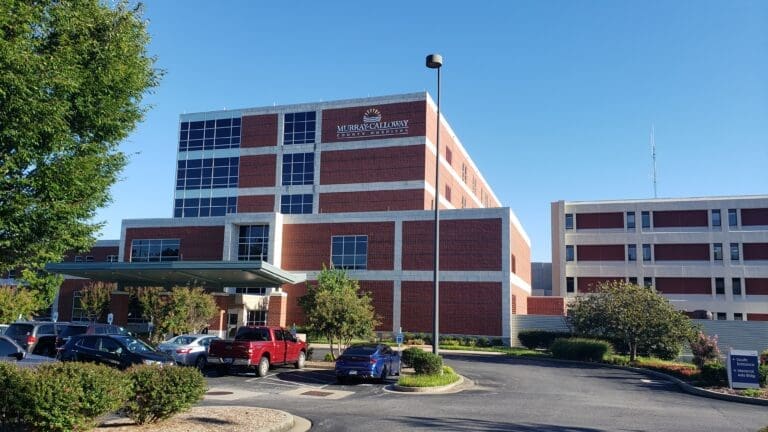
The Murray-Calloway County Hospital Board of Trustees Quality Committee will meet at noon in the hospital’s Garrison Board Room and viz Zoom (call 270-762-1102 for Zoom connection details).
MCCH Board of Trustees Finance Committee Regular Meeting
The Murray-Calloway County Hospital Board of Trustees Finance Committee will meet at noon in the hospital’s Garrison Board Room and via Zoom (call 270-762-1102 for Zoom connection details).