



MURRAY – “You have two active citations, ma’am.” That was the opening salvo in a 30-minute scam call Friday, during which men posing as sheriff’s deputies invented warrants, threatened arrest and pressed for thousands of dollars – just one of the many schemes the Calloway County Sheriff’s Office has been warning about for months.
This reporter received two spam calls Friday from men claiming to be CCSO officers. The first call was less than two minutes in duration as the caller hung up after it was suggested the call might be a scam. But the second, which came nearly three hours later, lasted more than 30 minutes.
Both calls came from the same number – 270-238-1319 – and started with roughly the same script.
“I’m gonna have to let you know at this time, ma’am, this call will be recorded and monitored not only for your safety but for judicial purposes as well. Is that understood, ma’am?” a man claiming to be “Sergeant Jim Price” said after exchanging pleasantries.
“This is a courtesy call, ma’am,” he continued. “I’ve got a few questions. I’m showing here in my documentation that this past Monday was a failed court appearance on December the first, ma’am. You were scheduled to take part in a federal trial as a potential expert witness. Is there a reason you didn’t attend?”
“Price” was polite and spoke with a strong southern accent. He advised he had documents showing a summons had been issued by mail in October and proof of service was returned to the clerk’s office.
“When you were deemed absent, ma’am, the judge did issue the two class D citations,” the self-proclaimed sergeant said. “They are under the assumption that you did receive it because someone actually took the first-class mail, tore the thing off and mailed it back in, said you would be there, which legally binded you, ma’am.
“When you didn’t attend, the judge did issue the two class D citations. They are both misdemeanors; they do have arrestable backing, however. One is for failure to appear; the other is for contempt of court. Now, you said you didn’t sign or receive that summons, ma’am, and I do believe you. Would you have a problem coming to the sheriff’s department so we can clear things up?”
Upon receiving a hesitant “yes” in response, “Price” continued, “You sound like I’m gonna arrest you or something ma’am. It’s nothing like that, we would just do a handwriting analysis and prove to the courts that you didn’t receive or sign for that summons, ma’am. If you didn’t have the prior knowledge, you can’t be held accountable; but as it stands right now, you do have two active citations.
“My supervisor asked me to place this courtesy call because he did a background check on you and seen that you do not have any infractions against you – minor or major – in the system, so he wanted to extend this courtesy. If you’re willing to come down to the sheriff’s department, ma’am, I’m gonna go ahead and place you on a brief hold and let you speak to him and that way y’all can clear things up if you’re willing to take care of this. Okay? Just one second.”
The scammers were not consistent, changing names and ranks as they went – moving from “sergeant” to “captain” to “detective,” a sequence that does not align with real law-enforcement hierarchy, where detectives fall below captains. More than names and ranks, each man also gave different instructions about how to correct the problem.
After being on hold for just under two minutes, “Price” returned, saying that his “chief” was on another line but asked him to explain the next steps in the meantime. He provided two codes – FTA 25 CEF1429 and COC 25 CEFX518 – and asked for them to be read back to him. Then he instructed to write “$4,200 preset appearance bond” with the codes.
“Now, that we have that, ma’am, I’m gonna go ahead and give you the information for where you need to go,” he said. “At this time, you’re gonna have to come into the Calloway County Sheriff’s Department. It’s gonna be located at 701 Olive Street, here, in Murray.”
“Price” continued, advising that there were two ways to handle the situation. “Though it appears to be a clerical error – I do agree with you on that – however, the judge has issued the two citations. There’s nothing we can do about that.
“There’s only two ways we can handle that – a criminal process or a civil process. Now, this courtesy call was extended as part of the civil process. So, I’m gonna tell you the criminal process first because it’s shorter and easier.
“So, the criminal process is kinda like this: you blatantly disregard this phone call, turn yourself into the sheriff’s department or just wait for a tag reader to, say, read your tag and run your name, at that time, you would be detained and housed for 72 hours, up to 14 days, until the honorable judge can see you. At that time, you would be able to tell him the same thing you’ve told us, and he would let you go, I’m sure.”
After being asked for the name of the judge who issued the “summons,” he advised it was Judge Greg Stivers. “He’s with the U.S. District Court. This is not a summons from the county, ma’am, it’s a federal summons. It was a U.S. District Court judge that signed that.
“Now, do you understand that process? The criminal way? That’s what we’re calling to avoid, ma’am. Listen, I just gotta tell you that because that is one of your rights. Now, the other way is a civil alleviation act.”
Notably, there is no such thing as a “civil alleviation act.” Regardless, the caller explained, “Due to your record, or the lack thereof, my supervisor’s asked me to place this courtesy call that way you do not have any infractions on your background.
“Basically, ma’am, what we’re gonna have you do is just come down here, do the handwriting and signature test, prove to the courts that you didn’t do it – shouldn’t take you more than 30, 45 minutes, depending on how fast you read and write – sign our digital keypad 10-15 times, cross-reference that with the signature on your driver’s license or government issued ID or any other signature you have on file in our database.
“At that time, ma’am, it will come back conclusive or inconclusive, and we’ll be able to just decide if you did sign or didn’t sign that summons because everybody’s signature is pretty much like a thumbprint. So, we will be able to prove that to the courts one way or the other. Now, if you didn’t sign that summons, ma’am, no harm, no foul. Everything goes back to normal. It’s taken care of. Shouldn’t take more than 45 minutes today; however, if you did sign that summons, ma’am, the officer is probably going to give you a lecture or something. It’s not that big of a deal, ma’am, but there is a process, a legal way we have to do stuff.”
At that point, “Price” said he would attempt, again, to get his supervisor on the line. After a three-and-a-half-minute hold, a different man came on. He identified himself as a captain, but the name he gave was unintelligible.
The “captain” reiterated everything “Price” said, minus the southern drawl, before going into more detail about the $4,200 so-called “preset appearance bond” that would have to be paid immediately. Although initially cordial, the “captain” quickly became sterner.
“You don’t have a criminal bail,” he explained. “You are posting a preset bond, which has been set forth by the judge, on your own accord. So, that means that you will, basically, pay the citation warrant at the court. You just wait around momentarily at the courthouse after doing the signature comparison, momentarily, after which you get a refund.
“Being that you have citation warrants – I’m not sure if you’re familiar with the law – but there is only two ways to alleviate a warrant; that’s either to have been to a government agency – police department, sheriff’s office, courthouse – to process that warrant, as meaning we have you in our custody; we take you through the formal booking. When the process is completed, we take you to a holding cell; you contact family, loved ones, notify them, ‘Hey, I’ve been arrested. I do not want to remain here until next week. Could you post bail for me?’ Then, they’ll go to a bond agency, post bond for you; we’ll get you in front of a judge come Monday.
“The civil mediation process, it allows you to take care of the citation warrants yourself without going through a detainment, and being that you don’t have criminal bail, you have a preset bonding, which is set forth by the judge, it is also a refundable bail. It’s basically that you’re showing forth your compliance, stating that you will comply with the sheriff’s office and go to the courthouse.”
The “captain” then advised that the total bond amount was $8,400 – $4,200 for each warrant – plus a $42 filing fee. He asked if the total amount could be paid today or if it would be necessary to file a hardship, adding that, if necessary, his superior could sign off on that.
“If you are not able to pay the preset bond in its entirety,” he said, “then basically, you notify me now; I notify the bonding agency, see if they’re able to reduce the citation warrants, meaning that we will, basically, have to merge them one with the other and sign off on that.”
When advised that it would not be possible to pay $4,200, much less $8,400, the “captain” audibly sighed.
“OK, um, once again, ma’am,” he said, “by law, we’re only able to assist you so far, and being that you’re not a criminal, we have not dispatched any officers to you; we don’t have anyone ‘on the lookout’ for you as well. You have to alleviate the warrants. If you do not alleviate the warrants, then we would have to process the warrants. And if we process the warrants, that means officers look for you; someone is dispatched to you; and once you are apprehended, you go through a formal booking procedure.”
Expressing confusion about how to correct the issue, this reporter asked if it was necessary to go the sheriff’s office. “OK. The sheriff’s office is if you’re intending to do a voluntary turn-in. … If you arrive on government grounds with arrestable offenses, by law, you would have to, basically, be arrested. So, you are able to take care of the citation warrants prior to arrival at that sheriff’s office or the courthouse.
“Once you arrive – at the courthouse, preferably – you’ll go through the signature comparison, where your signature will be compared electronically. There is a system called the NCIC; it’s an electronic database – National Crime Information Center database. Once you sign off on the electronic panel three to five times, it’s gonna be ran through that database. It’s 100% accurate. Once it comes back inconclusive – that you never signed the notice – that’s basically your adjudication. Once you are adjudicated of all guilt, you are free to go. It’s expunged from your record. You just stay around momentarily to receive your refund of the posted preset bond.”
Upon noting that the previous “officer” gave instruction to go to the sheriff’s office, the “captain” clarified, “The deputy before me, he’s basically an information officer, so he’s limited to certain authorizations. I’m a captain, so once again, I could authorize the procedure of you (taking care) of these citation warrants out of court; but if you go through the sheriff’s office, then we would have to take you through the formal booking process to proceed.”
“Let’s say you are in custody,” he elaborated, “if you were placed through a formal booking and were in our custody, you would have to remain in a contempt-of-court holding cell. You would remain there until you go before the magistrate judge, which will be on Monday. If no one posts bail for you between then and now, then that means you will remain in custody until we get you before that judge. The difference is you’re not remanded in custody and you’re not going through a formal booking. You’re basically bonding yourself out before you have to go through a procedure such as that.”
When asked what had to be done in order to do that, the “captain” said, “The civil mediation process, once again, which will be you arriving to a bonding agency that will allow you to post a preset bail that is refundable. They have to be licensed in order to do so. You go to a bonding agency, goes through the formalities, the procedure with that company. Once that’s completed, you go to the courthouse.
“You arrive at the courthouse with your receipt also your bonding voucher from that bonding agency. Take that with you; you have to scan that at the courthouse, basically, notifying that you are the individual that posted bail. Have your valid identification, your government-issued ID, once you scan that at the courthouse, that is also to notify the court clerk that you’re the individual to receive the refund. Once you do that, you do the signature comparison, and after it comes back inconclusive, no match, 10-15 minutes, you’re adjudicated, good to go; get you expunged, turn around and get your refund.”
He disappeared for approximately 30 seconds after being asked how to find a “bonding agencies,” advising, upon his return, “We would get in contact with them being that there is a preset bail in that they will have to refund you, so we will figure that out for you. It has to be a bonding agency that is licensed to do so. Being that you’re not in our criminal registry, you don’t know about the procedure or a bonding agency that will allow this, so we will do that part. We will find a bonding agency; but you do have to notify them whether you could post the preset bail, and I have to notify them as well.
“… This is a procedure that allows you to remain free. If you choose to go through the voluntary turn-in, the criminality, that’s totally fine; we’ll still assist you. We’re not against you. We just have a certain protocol we have to follow.”
Asked point blank “How do I deal with this?” he said, “So, basically, you would need a valid form of identification, your government-issued ID with your signature on there, and you’ll also need your preset bond amount in cash. Once again, if you’re not able to post the preset bond in its fullness, meaning $8,442, I’ll basically notify the bond agency; I’ll get my superior officer to sign off on this; we’ll have them merge the citations, one with another, that means that you’re not responsible for posting those two citations – 42 and 42 – it would basically be just ($4,200) all together.
“So, I’m gonna find my superior officer and see if he can sign off on that, get in touch with the bond agency, but you have to notify me if you are able to post the bond in its entirety or need a reduction whereas to hardship.”
Upon learning the bond could not be paid in full, the “captain” took a brief pause and said, “OK. That’s fine, ma’am. Notify me the number what’s closest possible to the objective number $4,242.” The response: “$1,000.”
“OK. I’ll notify my superior officer,” he said. “We may have to place you into a financial hardship. A financial hardship will be, basically, you know, stating that you are in a position where you cannot post this fully. So, the county will cover the rest of that, but you have to prove that you need the hardship. Once you arrive at the bond agency, you have show forth the proof that you need the hardship and not just want the hardship. Once you do so, they’ll already have the paperwork for us to sign off on it and the county to sign off on the rest of it, the rest of the balance. Allow me to notify my superior officer so that this can be documented and also get approval, OK? Give me one second.”
After another three-minute hold, “Detective Brian Cannon” picked up. “OK. I need to know how you want to proceed at this time, ma’am, so I can approve this process. My deputy just reached out to me, said you wanted to do it the civil way,” he said in a southern accent, not quite as thick as the “officer” who initiated the conversation 32 minutes earlier.
“Now, my deputy told me that you had a preset appearance bond and said you had $1,000 towards it of the original $8,442? OK. Well, at this time, ma’am, I will need you to gather you stuff and get in your vehicle. Let me know when you make it there. I’m gonna need you to tell me the name, the time of day and your odometer mileage. Pretty much, when you get there, ma’am, at that point, you just start to drive and you’re good. Alright?”
The last question asked, “Wait. Can you tell me where I’m going?” proved to be too much as “Cannon” hung up the phone and never called back.
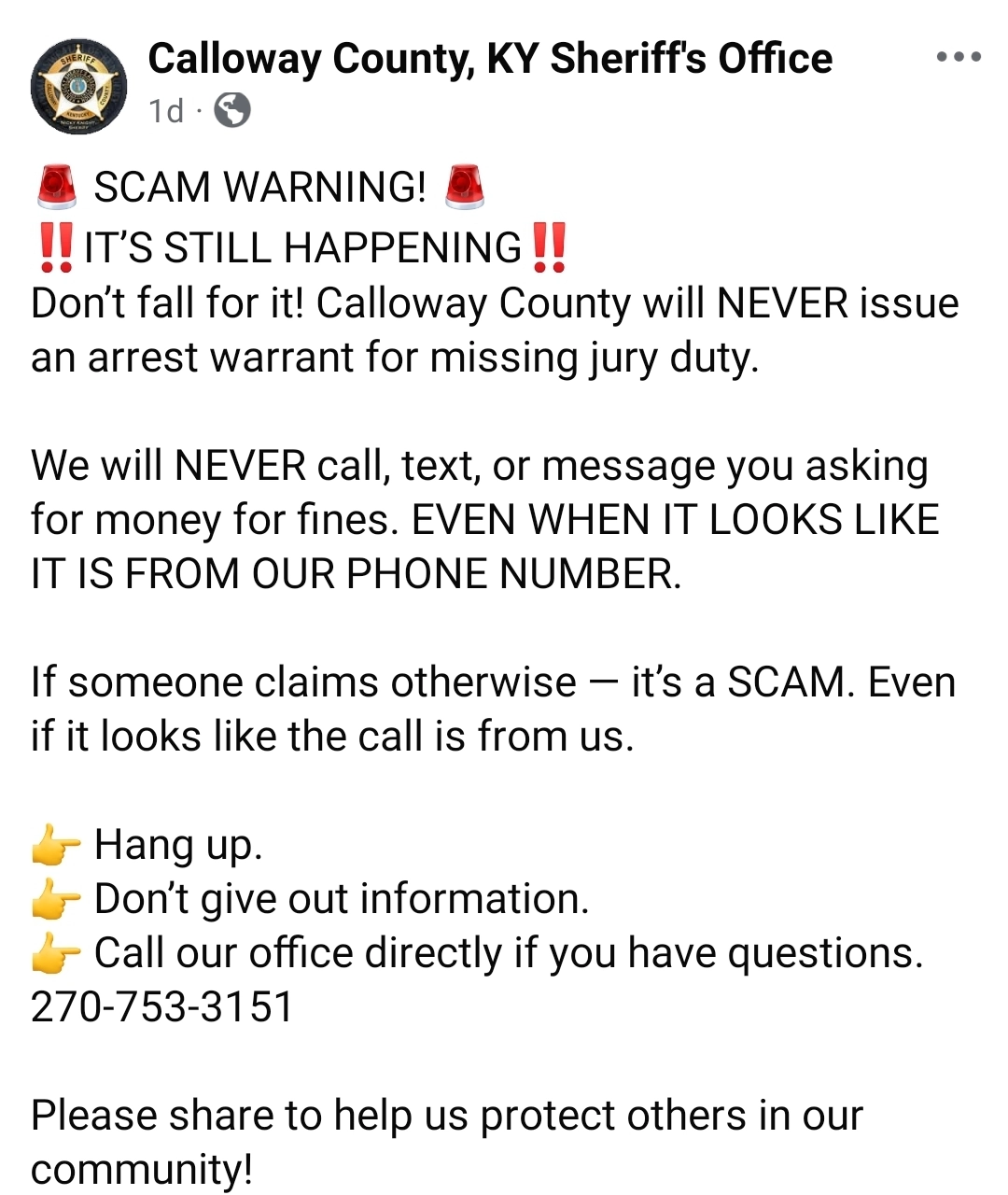
The Sentinel contacted CCSO and confirmed that the calls were scams. For weeks, the department has made posts on social media, alerting the community of reports that scammers are impersonating CCSO officers, attempting to collect money for outstanding warrants.
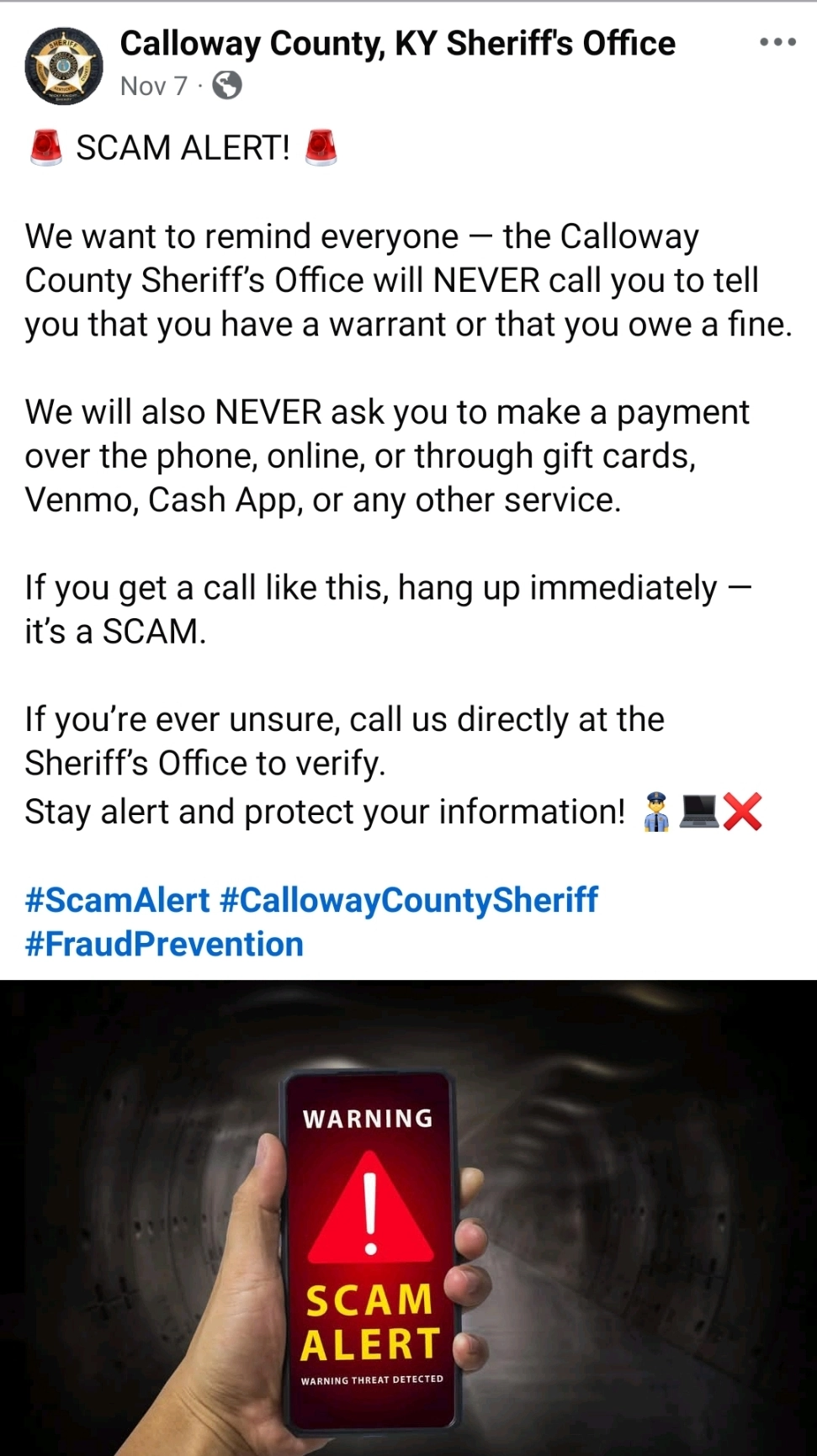
“We will NEVER call, text, or message you asking for money for fines. EVEN WHEN IT LOOKS LIKE IT IS FROM OUR PHONE NUMBER. If someone claims otherwise – it’s a SCAM,” CCSO wrote in a post on Thursday.
To avoid phone scams, AARP (American Association of Retired Persons) promotes awareness of four warning signs: unsolicited calls; suspicious timing, such as around the holidays; promising deals or financial gains; and automated sales calls. The organization also suggests signing up for the National Do Not Call Registry, using mobile apps to screen calls, not answering calls from unknown numbers, being suspicious of one-ring calls and never share personal or financial information with unknown callers.
In addition to contacting local authorities, if you believe you have been the victim of a scam, report it to the Kentucky Attorney General’s Office by calling 888-432-9257 or using the online scam report form.